EN
EN

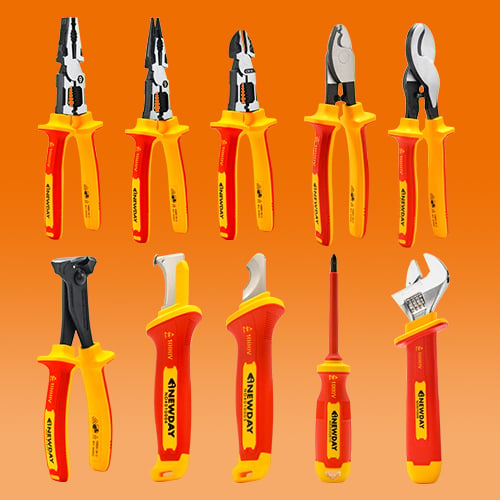
In professional electrical infrastructure, renewable energy maintenance, and industrial panel building,帶电作业 (live-line work) is an unavoidable reality. The primary defense between a technician and a fatal current is the insulation on their hand tools. Not all "insulated" tools are created equal. This guide examines the rigorous engineering and VDE certification process that defines professional VDE Insulated Tools (VDE CERTIFICATION INSULATED TOOLS Category).
1. The VDE Standard: Beyond Basic Plastic Grips
Standard hand tools often feature rubber or plastic handles designed for comfort, not electrical isolation. Under a 1000V AC load, low-density materials can experience dielectric breakdown, allowing the current to arc directly through the handle into the operator’s hand.
At Zhangjiagang Tianxin Tools Co., Ltd., our iNEWDAY line adheres strictly to IEC 60900 and VDE (Verband der Elektrotechnik) standards.
- High-Purity Insulation Polymers: We utilize proprietary flame-retardant, high-density polymers that maintain their dielectric constant even under high-humidity or chemical exposure.
- Molecular Bonding: The insulation is injection-molded directly onto the tool's steel core, ensuring there are no air gaps or voids where electrical charge could accumulate.
2. The Individual Water-Bath Test: 10x Safety Buffer
The cornerstone of VDE reliability is the individual test. Unlike standard tools where only samples are checked, every single iNEWDAY VDE tool undergoes a water-bath test:
- The 10,000V Threshold: The tool is submerged in water while a 10,000V AC current is applied for 3 minutes. The leakage current must remain below negligible levels. This 10x safety factor ensures that when a technician uses the tool on a 1000V line, they have an absolute margin of safety.
3. Extreme Environment Durability
Industrial job sites are harsh. Insulation must not only stop electricity but also survive mechanical abuse:
- Cold Impact Test: Tools are chilled to -25°C and struck with weights. The insulation must not crack or chip.
- Pull-Off Test: After being heated to 70°C, the insulation is subjected to a 500N pull force to ensure it never slides off the steel handle.
❓ FAQ: VDE Insulation & Electrical Work
Q1: How do I know if a tool is actually VDE certified for 1000V work?
A: Look for three specific marks on the tool handle: 1. The VDE logo (double-triangle), 2. The 1000V symbol, and 3. The IEC 60900 standard reference. Professional VDE tools also feature high-contrast yellow and red dual-color handles as a visual safety indicator.
Q2: Can I use VDE tools on lines higher than 1000V?
A: No. Standard VDE insulated hand tools are strictly rated for work on live components up to 1000V AC or 1500V DC. For higher voltage grid work, specialized PPE and remote handling equipment are required.
Q3: Does the insulation lose its safety properties if it gets scratched?
A: If the insulation is deeply gouged or scratched to the point where the inner color layer or the steel core is visible, the tool is no longer safe for live-line work and should be retired immediately. This is why Tianxin utilizes a dual-color system—the appearance of the bottom color serves as a wear indicator.
Q4: Do you provide bulk customization and VDE certification reports for B2B buyers?
A: Yes. As an ISO-9001 certified factory with 23 years of exporting history, we provide full technical documentation and VDE/GS certificate copies to our B2B partners. We also offer OEM services for handle branding and custom packaging while maintaining strict VDE compliance.